Alright then. Heads-up. This probably isn’t going to be the warm, fuzzy, lightly satirical morsel of magical discourse you’ve come to expect from me, but it’s Suicide Awareness Month, and the following, I reckon, is worth illuminating.
More people die by suicide than in road traffic accidents
In 2024, 6,190 deaths by suicide were registered in England and Wales. That is around 17 people every day. By contrast, 1,602 people died in road traffic collisions across the whole of Great Britain that year. In the United States, 48,824 people died by suicide in 2024 (134 people every day). In Australia, 3,326 (9 per day). There are caveats. Suicide data can be difficult to obtain and depends upon how deaths are recorded and classified. In some countries suicide remains heavily stigmatised, criminalised, religiously prohibited, poorly recorded, or hidden within other categories of death. The numbers we have are therefore only the numbers we have managed to count.
The ubiquity of suicide
Suicide confronts us with something quintessentially human. We share an awareness that we are alive and an awareness that, eventually, we won’t be. We know death exists. We fear it, contemplate it, philosophise about it, yet simultaneously dare not look directly at it, much like the sun, or your parents kissing. Many people will also experience periods of despair in which the prospect of simply pressing the off switch enters consciousness, even fleetingly. Despite the universality of that experience, we are comically bad at talking about it. We are quite creative in finding ways not to.
Talking about suicide in code
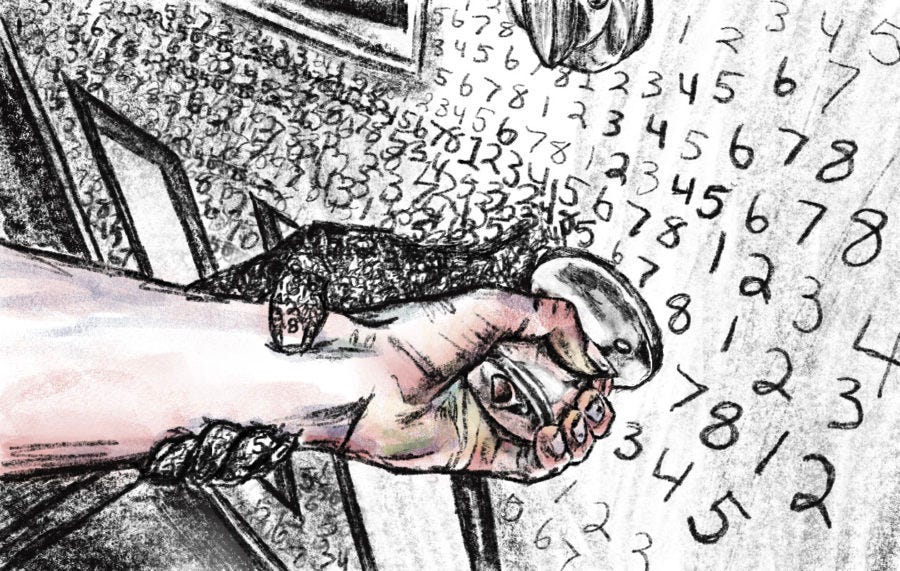
It is Suicide Awareness Month, and people on social media are literally talking about suicide in code. Letters are replaced with numbers or symbols because creators worry that writing the word itself will lead to content being restricted, suppressed, or shadow-banned.
I’ve also been reticent about posting videos discussing suicide because I’ve wondered whether I’ll somehow get into trouble, or whether talking openly about suicide might “trigger” somebody, as though I am introducing people to an idea that human beings haven’t contemplated for thousands of years.
It is bizarre - the pervasiveness and universality of this collective experience, dovetailed with the silence that it imperceptibly mandates people into.
“A person has been hit by a train”
Just over a year ago, I spent an earth-shatteringly fabulous weekend in London with two people I love (most of the time) - my uncle Paul and my cousin Callum. It was summer, the weather was perfect, and the weekend was full of frivolity and joy. On the way home, we arrived at St Pancras to find complete bedlam. Almost all trains heading north were delayed or cancelled. People were staring angrily at departure boards and trying to work out how they were going to get home.
An announcement came over the station speakers.
“We are sorry to announce that all trains from London St Pancras to Leeds, Nottingham, etc. have been cancelled. This is due to a person being hit by a train. We apologise for any inconvenience this has caused.”
Someone had just lost their life and several other lives had, in all likelihood, been irreparably changed. Somewhere, there were family members and friends who were about to receive irresoluble psychological despair over the phone. A train driver would likely now retire and spend months awaiting treatment for PTSD. Police officers, paramedics, and railway staff were dealing with what had happened. For an imminent group of people, life would now divide itself permanently into the time before they received a call and the time after it.
At the train station, though, it was an inconvenience. A stutter in time. Someone would be late for lunch. A couple might lose their yoga class reservation. Somewhere in a London office, a team of board members would be sitting, increasingly irritated, around a conference table, waiting for a man with a laptop full of profit-and-loss graphs to turn up. Meetings would be cancelled, appointments missed, plans rearranged. Hundreds of people stood underneath a departure board, frustrated because their evening had been mildly disrupted, while somebody had just died.
I looked at Paul and said, “Did you hear that?”
“What?”
“A person being hit by a train.”
It was the passivity of the language. A person wasn’t merely hit by a train. A person had thrown themselves in front of a train, presumably because the pain of existence had surpassed the perceived pain of death. But any intention was masked in language. Despair was hidden. The determinism itself obfuscated. What remained was something that sounded accidental: a person was hit by a train. If there was any intentionality at all - it was with the train, not the person. The train did the hitting.
Of course, there are good reasons for a public announcement not to go into forensic detail about the circumstances of a death. But that was precisely what Paul and I began talking about. A human death had been translated into the most neutral and passive language possible, followed almost immediately by a nod to inconvenience.
Paul looked up, alerted, and back at me, “And you know what? It’s pre-recorded.” Wow. Right. Woah.

So, this happens often enough that the railway system needs a ready-made recording for it. Presumably, at some point, there has been a board meeting or a team of people sitting around a table discussing how to communicate these deaths. This happens with such monotonous regularity that they need something pre-recorded.
They have considered the wording, made it neutral enough to be deployed automatically, recorded it, stored it, and created a system through which it can be played whenever another person dies on the railway. And I, of course, understand that there is hardly any alternative (though I do have a suggestion later). This is not a critique of the railway employee who presses the announcement button, but a wider exploration concerning how we deal with suicide.
The systemic methods used to disappear it, to make it non-existent, have been, in many ways, successful. It is everywhere and yet rendered invisible by our collective unwillingness to look directly at it. The automated announcement is a startling Orwellian metaphor for this. Something devastating has happened, but systemic neutrality rushes in to prevent an emotional response. Language becomes procedural, euphemistic, sanitised. What has happened is obscured enough that nobody has to name it.
And perhaps that is the most disturbing part. We have obfuscated suicide from view so effectively, and for so long, that we now recoil at its mere mention. The silence has become so normal that speaking plainly about suicide can feel more confronting than the systems designed to keep it unspoken.
We still afraid to talk about suicide
A lot has changed in mental health awareness. Our psychological vocabulary has expanded enormously. People talk about anxiety, depression, trauma, attachment, boundaries, burnout, ADHD, and therapy in ways that would have seemed unusual twenty years ago. Our willingness to speak directly about suicide has not developed at the same rate.
Having spent five years working for Samaritans, researched suicide, worked on suicide prevention in prisons, and worked clinically with people experiencing profound despair, I’ve noticed a marked exceptionalism surrounding it. Talk to me about anxiety, fine. Depression, trauma, psychosis, addiction, fine. But please don’t involve me in suicide. It seems to occupy a radioactive psychological category.
There is an almost superstitious quality to our discomfort surrounding suicide, as though looking directly at the idea for too long might somehow make it happen. We worry that asking someone about suicide might implant the idea, legitimise it, or nudge them towards something they otherwise wouldn’t have considered. There is no evidence for this fear (on the contrary) but it remains persistent.
So when someone says, “I don’t want to be here anymore,” we try to talk them out of it. We remind them of their family, their career, their future, tell them things aren’t as bad as they seem, or encourage them to focus on the positives. These responses may come from love and fear, but they serve only to reduce our own discomfort. And in our urgency to talk somebody out of feeling suicidal, we make them unacceptable.
Asking directly about suicide
There are better questions available to us. We can ask:
“What are you deliberately not talking about right now?”
“What are you avoiding telling me?”
“How long have you felt this way?”
“Do you remember a time when things felt different? What was that like?”
“What has become so painful that death has started to feel like an alternative?”
“When you think about dying, what do you imagine it would give you relief from?”
“Do you want to die forever or die for a while?”
“Are you thinking about suicide?”
“Have you thought about how you might do it? Would you write a letter?”
“What has kept you here so far?”
“Who else knows that you’re feeling like this?”
“What would make the next few hours feel more manageable?”
I know full well that some of you felt visceral discomfort even reading the fourth question from the bottom. Why? Are you worried that asking it might somehow implant the idea? Are you protecting the person from the question, or protecting yourself from the discomfort of asking it? Someone experiencing suicidal thoughts is already thinking about these things. Refusing to ask does not make those thoughts disappear. It just means they may have to think about them alone. Until we can actually listen to the answers and resist the urge to immediately make them more comfortable for ourselves, we will not reach people in a truly compassionate way.
There is also an understandable instinct to tell someone contemplating suicide that their problems are temporary and suicide is permanent. There is truth in the irreversibility of that decision, of course. But slogans can become another way of moving too quickly past what the person is actually telling us because, from inside suicidal despair, the problem doesn’t feel temporary. It feels like everything.
Awareness requires conversation
Suicide Awareness Month is obviously about awareness (my powers of observation are routinely complimented by peers), but I wonder - how much more awareness do we need? We know suicide exists, we simply need to get better at talking about it.
Seventeen people a day in England and Wales. Around 134 in the United States. Around nine in Australia. Those numbers represent people who, at some point before their deaths, interacted with friends, relatives, colleagues, doctors, therapists, teachers, managers, neighbours, and strangers.
We cannot know which conversation might alter what happens next. But we can become more willing to have it.
If you are thinking about suicide, or worried about someone who is, you can talk to someone now. UK and Ireland: Samaritans, 116 123. United States: call or text 988. Australia: Lifeline, 13 11 14. Suicide & Crisis Lines in Dubai: Al Amal Psychiatric Hospital – Dubai 800-11111; Rashid Hospital – Dubai 04 2192000. Elsewhere, contact your local emergency services.