Every year, around the end of October, we’re subjected to the same monotonous social ritual in which otherwise tolerable adults collectively decide that dressing up as a naughty nurse, a blood-soaked zombie, or some other equally uninspired character is not only tremendous fun, but something everyone else ought to enjoy too. And if you don’t? Well, you’re boring. Someone who doesn’t know how to have fun. Someone who needs to lighten up, get involved, and stop taking life so seriously.
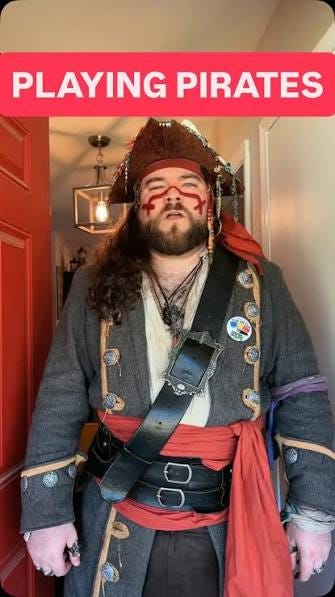
I’ve spent a sizeable chunk of my adult life being encouraged, cajoled, and occasionally emotionally blackmailed into attending fancy dress parties. I’ve endured the discussions about costumes, the insistence that everyone must participate, and the familiar suggestion that refusing to dress up is somehow evidence of a defective personality. I’ve never really understood it. I am an eager and enthusiastic participant in the art of hedonism - just ask my parole officer. What I don’t particularly enjoy is being told that in order to indulge in it, I must first dress as a fucking pirate.
What fascinates me, particularly as a psychologist, is the extraordinary contradiction at the centre of all this. The person who refuses to participate in an almost universally observed annual tradition is accused of being boring, while the people doing precisely what millions of other people are doing, at precisely the same time, in very similar costumes, are supposedly the interesting ones. Surely, if we’re going to accuse someone of being boring, we ought to reserve that judgement for behaviour that is predictable, conventional, repetitive, and entirely lacking in originality. Halloween fancy dress satisfies almost every one of those criteria.
There is something wonderfully absurd about a room full of adults dressed as vampires, witches, and sexually adventurous healthcare professionals congratulating themselves on their spontaneity. You’re not being spontaneous. You’ve spent three weeks ordering an outfit from Amazon because a date on the calendar told you to. The supposedly rebellious act of dressing up has become so thoroughly institutionalised that refusing to do it is arguably the more unconventional choice.
And yet, somehow, I’m the boring one. (It’s not that deep, Christian. It’s just Halloween. Yeah yeah. Whatever).
The psychology of compulsory fun
Psychologists have spent decades studying the ways in which groups influence individual behaviour, often without anyone explicitly recognising that influence. Solomon Asch’s famous conformity experiments in the 1950s demonstrated how readily people could be persuaded to agree with an obviously incorrect judgement when surrounded by others expressing the same opinion. His experiments concerned judgements about the lengths of lines, not whether a grown man should dress as a zombie, but the underlying question is relevant: how much of what we do reflects our own preferences, and how much reflects our desire to avoid standing apart from the group?
Halloween provides an illustration of normative social influence, the tendency to conform because we want to be accepted, liked, or at least spared the discomfort of social disapproval (no! It’s just a bit of fun. Jeez...). Nobody necessarily forces you to wear a costume, of course. The coercion is usually much subtler. It’s the disappointed expression when you say you’re not dressing up. The repeated questions about why you’re being difficult. The suggestion that you’re spoiling the atmosphere. The implication that your unwillingness to participate is somehow preventing other people from enjoying themselves.

And that’s what I find irritating. My decision not to wear a ridiculous costume has absolutely no bearing on your ability to enjoy yours. If your evening depends upon everyone else participating in precisely the same ritual, perhaps the problem isn’t my reluctance. Perhaps your enjoyment is rather more fragile than you’d care to admit.
There’s also a connection here to psychological reactance, a concept developed by Jack Brehm in 1966. Reactance describes the motivational response that can occur when people perceive their freedom of choice to be threatened. Put simply, the more someone insists that you must do something, the less inclined you may become to do it. This doesn’t necessarily mean you disliked the activity in the first place. Sometimes the pressure itself transforms something potentially enjoyable into something deeply unappealing.
I can quite easily imagine attending a party where someone happens to be wearing a costume and finding it amusing. I can appreciate a particularly clever outfit. But the moment participation becomes an expectation, the entire exercise loses its appeal. What might otherwise have been a laugh becomes another social obligation, complete with its own rules and informal sanctions.
(You’re overthinking it, Christian. Just put the f-ing costume on).
When fun becomes a performance
There’s a further psychological dimension to all this, which concerns the difference between doing something because we enjoy it and doing something because we feel obliged to demonstrate that we’re enjoying it.
Self-determination theory, developed by Edward Deci and Richard Ryan, distinguishes between different forms of motivation, particularly the extent to which behaviour is experienced as autonomous or controlled. Activities undertaken voluntarily, because they are personally meaningful or enjoyable, tend to have a very different psychological quality from activities performed to satisfy external expectations or avoid criticism.
This is particularly relevant to the social performance of fun. We seem increasingly preoccupied with demonstrating that we’re having a wonderful time, rather than simply having one. The photographs, the coordinated outfits, the elaborate preparations, the endless insistence that everyone is going to have the BEST NIGHT EVER. Halloween has become another opportunity to manufacture a socially recognisable version of enjoyment, one that can be photographed, uploaded, and publicly validated.

Of course, plenty of people love Halloween. They enjoy the creativity, the theatricality, the costumes, and the opportunity to become someone else for an evening. I have no difficulty accepting that. What I reject is the mandatory fun aspect of it all. Anything ubiquitous and socially coerced is unarguably antithetical to fun.
Sociologist Erving Goffman (clearly the only scholar I’ve ever read) famously described social interaction through the metaphor of theatrical performance, suggesting that much of everyday life involves managing the impressions we create for other people. Halloween is an almost comically literal example of this. We put on costumes, adopt characters, and perform versions of ourselves for an audience. But the more revealing performance, to my mind, is not the person dressed as Dracula. It’s the person pretending to enjoy the entire spectacle because admitting otherwise would invite accusations of being dull, antisocial, or miserable.
The problem with being called boring
The accusation of being boring reveals how casually we confuse conformity with personality. Someone who doesn’t enjoy fancy dress is considered boring, but someone who enthusiastically participates in exactly the same annual ritual as everybody else is considered fun, adventurous, and spontaneous.
There is no logical basis for that distinction.
If anything, the refusal to participate in an established social convention might suggest a degree of independence, although I wouldn’t go so far as to claim that refusing to wear a costume makes someone inherently more interesting either. That would simply reverse the same ridiculous judgement. My point is that personality cannot reasonably be inferred from whether someone enjoys dressing up once a year.
Being interesting has far more to do with curiosity, imagination, humour, experience, and the capacity to engage with other people than it does with one’s willingness to wear a synthetic wig and pretend to be a character from a Netflix series.
And there’s something rather revealing about the fact that the accusation of being boring is so frequently deployed against people who decline to participate. It’s a very effective form of social pressure because it targets something most people would prefer not to be perceived as lacking: social desirability. Nobody particularly wants to be considered dull. Consequently, calling someone boring becomes a convenient way of encouraging conformity without having to explain why conformity should be desirable in the first place.
It’s also intellectually lazy. Rather than accepting that someone has a different preference, we pathologise their reluctance. They’re miserable, uptight, antisocial, or incapable of having fun. We turn a perfectly ordinary difference in taste into a judgement about character. Perhaps the better question isn’t why some people dislike Halloween, but why others find that dislike so antisocial.
(At this point, I’m aware I’ve devoted considerably more intellectual energy to Halloween, and I am earning the labels ‘miserable’ and ‘boring’).
There are exceptions, of course
Now, before anyone concludes that I’m entirely incapable of appreciating Halloween, I should mention my dear friend Chris, a firefighter in New York, who somehow manages to make the whole thing thoroughly entertaining. Chris does Halloween differently, and whenever I’ve experienced his version of it, I’ve had an absolutely brilliant time.
And I think that’s important, because it illustrates precisely what I’m arguing. My objection isn’t to Halloween as a date, nor to people dressing up, nor even to the possibility that a costume party might be enjoyable. My objection is to the assumption that costumes are intrinsically entertaining, that dressing up is somehow a substitute for imagination, and that participation ought to be treated as a social obligation.
Chris understands something that many Halloween enthusiasts seem to miss. The fun comes from the people, the atmosphere, the humour, the effort, and the experience itself. The costumes might contribute to that, but they don’t magically create it. A tedious party doesn’t become interesting because everyone is wearing plastic fangs. An uninteresting person doesn’t suddenly become fascinating because they’ve dressed as the Joker. And a room full of people who have been pressured into participating doesn’t necessarily become a happier room simply because everybody looks ridiculous.
When Halloween is creative, imaginative, and enjoyable, I’m perfectly capable of appreciating it. When enthusiasm becomes compulsory, I'd rather stay home and take in a documentary about municipal drainage. Or perhaps open up YouTube and watch a man named Clive explain the history of British roundabouts.
The freedom not to participate
I don’t think we spend enough time questioning the assumptions embedded in our collective definitions of fun. We accept certain activities as inherently enjoyable because they’re culturally recognised as such, and we become suspicious of anyone who doesn’t share the enthusiasm. Halloween is simply one example of a much broader phenomenon. Compulsory Christmas parties, organised team-building exercises, mandatory birthday celebrations, board games, yoga, and the dreaded instruction to “get everyone involved” all operate according to a similar logic.
The assumption is that enjoyment can be organised, prescribed, and collectively enforced. It definitely can’t.
(For Christ’s sake, Christian. It’s a plastic skeleton and a few drinks. Nobody’s asking you to overthrow the government. WHY NOT?).
And perhaps there’s a certain irony in the fact that a celebration so heavily associated with disguise, transformation, and stepping outside ordinary identity has become another occasion on which people are expected to behave in exactly the same way as everybody else.
So, by all means, dress up. Be a witch, a vampire, a naughty nurse (so weird, by the way), or whatever other deeply original character you’ve bought on Amazon. Throw a party. Have a wonderful evening. Take photographs. Enjoy every second of it. I’m pleased if you do.
But you can’t tag the non conformists ‘boring’. Not a chance.
Because if your idea of originality is doing what millions of other people are doing, on the same evening, for the same reason, wearing variations of the same costumes, perhaps we need to reconsider which one of us is being unimaginative.
And if Chris invites me to New York for Halloween, I’d absolutely be there.
I might even dress up. As a pirate.
References
Asch, S. E. (1956). Studies of independence and conformity: I. A minority of one against a unanimous majority. Psychological Monographs: General and Applied, 70(9), 1–70.
Brehm, J. W. (1966). A theory of psychological reactance. Academic Press.
Deci, E. L., & Ryan, R. M. (1985). Intrinsic motivation and self-determination in human behavior. Plenum Press.
Goffman, E. (1959). The presentation of self in everyday life. Doubleday.
Hayes, S. C., Strosahl, K. D., & Wilson, K. G. (2012). Acceptance and commitment therapy: The process and practice of mindful change (2nd ed.). Guilford Press.