Before we get into any of this, an important caveat.
I am a psychologist and I work with OCD. I have also lived with OCD myself. But this article is educational. It is not a substitute for individual psychological assessment or treatment. These exercises are based on principles used within Exposure and Response Prevention (ERP), one of the best-supported psychological treatments for OCD, and ideally this kind of work is done with the support of a psychologist or other clinician who understands OCD and is properly trained in treating it.
Please prioritise your own wellbeing. If something here feels inappropriate for you, or you find that attempting it is making things significantly worse, stop and seek appropriate professional support.
There is an important distinction here, though. Feeling uncomfortable does not necessarily mean an exercise is going badly.
Working with OCD involves learning to experience discomfort and uncertainty without immediately trying to make them disappear. That is uncomfortable, especially at first. If the whole problem is that your mind has become exceptionally good at escaping certain thoughts, feelings and uncertainties, learning to stop escaping them is unlikely to feel pleasant straight away.
Understanding the OCD Cycle
OCD primarily runs on two things: an unwillingness to sit with uncomfortable thoughts and an intolerance of uncertainty.
A thought appears. It feels awful. You want it gone.
So you do something.
You check. Google. Ask somebody for reassurance. Review what happened in your head. Avoid something. Say a phrase to yourself. Pray. Check your memory. Check your body. Analyse whether you really meant the thought. Tell yourself you’re a good person. Try to replace the thought with a better one.
And, briefly, it works. Then another worry / obsession turns up, and you’re locked back into the stimulus-response trap.
The cycle looks like this:
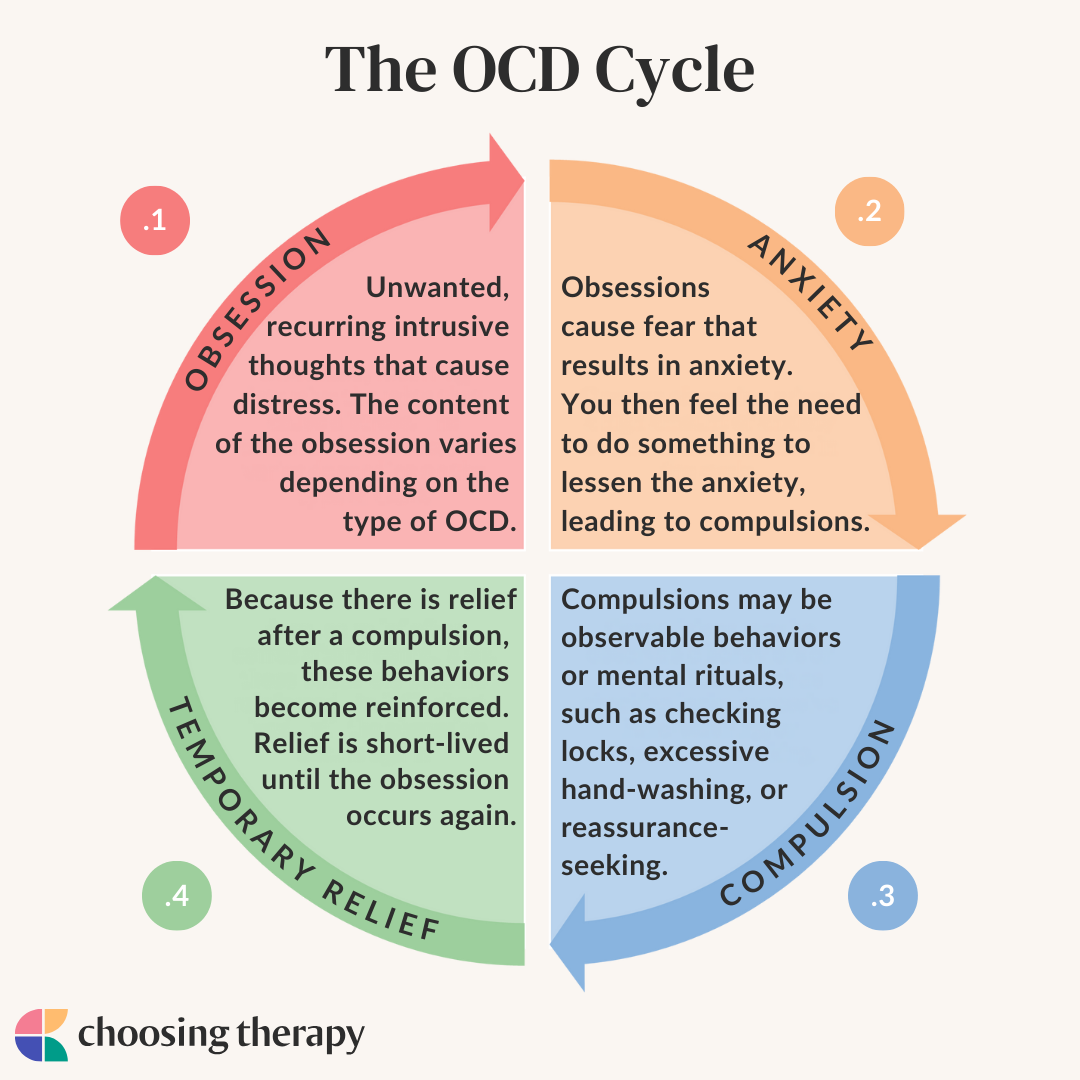
Stimulus → Intrusive thought → Anxiety/uncertainty → Desire for safety → Compulsion → Temporary relief → New stimulus → New intrusive thought
The most important word there is temporary.
The compulsion gives you some relief, which teaches your brain that the thought required a response. The next time the thought appears, your brain already knows what to do: sound the alarm and get you to perform the compulsion again.
Anyone who has lived with OCD will know this cycle well. It’s not too dissimilar to giving into any craving or addiction. Alcohol soothes anxiety for a while, workaholism distracts from low self esteem while you’re in it, doom scrolling can feel rhythmic and relaxing in the moment, but there is always a debt to pay.
Think of every compulsion as a certainty token. At first, one token buys you quite a lot of certainty. One check or Google search, for example, might give you relief for the whole day. But the price keeps going up, while the certainty you get in return keeps shrinking. Soon, one check isn’t enough. You need five. And the relief doesn’t last a day anymore. It lasts an hour. Then ten minutes. You’re spending more and more certainty tokens for less and less certainty. Therein lies the trap of compulsions: rapidly diminishing returns. They don’t satisfy your need for certainty. They increase it. And the more you trade in this economy, the more you train your brain to treat uncertainty as a threat.
This is why treatment for OCD involves gradually learning to experience the thought without automatically performing the response. In ERP, this means exposing yourself to the thoughts, images, situations or feelings that provoke the obsession while resisting the compulsive behaviour that would ordinarily follow. NICE specifically recommends exposure to obsessive thoughts alongside prevention of mental rituals and neutralising strategies for people whose compulsions happen primarily in their heads.
The aim isn’t to prove the thought wrong. It isn’t to achieve certainty. And it isn’t even necessarily to make yourself feel better.
It is to discover that you can have the thought without having to do anything about it.
Here are three exercises I have used with clients in therapy and, importantly, used in my own life when overcoming OCD.
1. Buy an Egg Timer
Preferably from an independent shop. Support local businesses and all that. But, realistically, you’re probably going to Amazon it. Buy an actual egg timer and set it for one minute.
For that minute, deliberately allow yourself to think about whatever you have been desperately trying not to think about.
The thought you’ve been suppressing. The question you’ve been trying to answer. The image that makes you feel sick. The uncertainty you’ve been Googling for three hours trying to resolve.
For one minute, give it your full permission to exist.
Think it. Say it in your head. Say it aloud. Write it down.
And then comes the difficult bit: don’t do anything to neutralise it.
Don’t solve it. Don’t reassure yourself. Don’t replace it with something nicer. Don’t tell yourself, “I don’t want this to happen.” Don’t repeatedly remind yourself, “I’m a good person.” Don’t start constructing an argument for why the thought isn’t true.
Just let it sit there.
You don’t have to agree with it. You don’t have to like it. You don’t have to believe it.
You’re practising having it.
One minute.
When the timer goes off, if you still want to perform the compulsion, you can. We’re starting small.
Try this every day for a week. If one minute starts becoming manageable, make it two. Then three. Then five.
There is no prize for rushing.
What you’re practising here is the ability to remain in contact with discomfort and uncertainty without immediately escaping it. Modern approaches to ERP increasingly emphasise precisely this: learning that anxiety, doubt and intrusive thoughts can be experienced and tolerated, and that compulsions are not necessary for us to cope with them.
You’re teaching yourself something incredibly simple: I can have this thought and leave it unanswered.
2. Sing It
This one sounds ridiculous. That’s partly why I like it.
Once you are becoming more comfortable saying an intrusive thought aloud, try singing it.
Take the thought and put it to the tune of Happy Birthday. Or Jingle Bells. Or whatever irritating tune your brain happens to know well enough to reproduce without effort.
Then sing the intrusive thought. I have done this myself.

Some of my own intrusive thoughts were about harming people. I spent part of my career working in prisons and coming across people who had committed awful crimes. OCD found plenty of material there. My mind could generate images and thoughts of me doing awful things to other people precisely because those were some of the most disturbing things I could imagine.
So I learnt to say those thoughts aloud. And sometimes I would sing them.
It sounds absurd. It can feel absurd. But that’s kinda the point.
The thought has probably spent months or years intruding into your mind accompanied by an enormous sense of seriousness and urgency:
Your mind says: Pay attention to this. What does this mean? Why did you think that? What if you actually wanted it? You must be a terrible person. You must’ve done something awful. You must be seriously ill. Maybe you don’t love them. You need to work this out. Now!
Singing the thought changes your relationship with it. You’re no longer automatically treating its intrusion as an instruction to begin an investigation.
This idea also has some overlap with cognitive defusion from Acceptance and Commitment Therapy. Defusion exercises deliberately alter the way we interact with language so that we can experience a thought more clearly as a thought rather than automatically responding to it as a fact, warning or command.
You’re not singing it to prove it isn’t true.
You’re singing it because your brain has been treating a sentence in your head as an emergency.
Let it be a sentence. Even a sentence sung badly to Happy Birthday.
3. Delay the Compulsion
Once you’ve become reasonably comfortable with the first exercise, start working directly on the other half of the cycle: the compulsion.
When an intrusive thought appears and you feel that familiar urge to do something about it, get the egg timer again.
This time, set it for five minutes.
For those five minutes, you don’t perform the compulsion.
If your compulsion is Googling, don’t Google. If it’s asking somebody for reassurance, don’t ask. If it’s checking, don’t check. If it’s mentally reviewing something that happened yesterday for the 46th time to determine whether you definitely behaved appropriately, don’t review it.
You don’t need to distract yourself from the thought either. Let it be there.
And notice what your mind does.
It will probably produce some excellent arguments for why this time is different.
You really should check this one. This isn’t OCD. You need to know. Just check once. What if this is the one time you ignore something important?
Fine. Those thoughts can come too. Thank them for the reminder, but don’t engage any further. Your only task is to delay your response for five minutes. When the timer finishes, you have permission to perform the compulsion if you still choose to.
Then, over time, start extending the gap. Five minutes becomes ten. Ten becomes twenty. Twenty becomes an hour.
What you’re gradually changing is the relationship between thought and compulsion. OCD wants those two things almost welded together: thought appears, response happens. We’re putting space between them.
And something interesting can begin to happen in that space. You learn that an intrusive thought doesn’t automatically require action. You learn that uncertainty can exist without being resolved immediately. You learn that an urge can be extremely uncomfortable without being an instruction.
Eventually, the goal is no longer simply delaying the compulsion. It’s discovering that you don’t need to perform it at all.
The Goal Isn’t to Stop Having Intrusive Thoughts
This is one of the most important things I learnt from my own experience with OCD. And it might be the most difficult bit of work with clients who are suffering. If your objective becomes I must stop having intrusive thoughts, you’ve given yourself another impossible standard to monitor. Human beings have strange thoughts.
Aggressive thoughts. Sexual thoughts. Blasphemous thoughts. Thoughts about death. Thoughts about illness. Thoughts about people we love. Thoughts that contradict our values. Thoughts that seem to appear from absolutely nowhere.
OCD isn’t simply the presence of these thoughts. The problem develops in what happens next: the significance we give them, the certainty we demand about them and the things we repeatedly do to make ourselves feel safe again.
So these exercises aren’t really about getting better at controlling your thoughts.
They’re about becoming less obedient to them.
One minute with a thought. A ridiculous song. Five minutes before a compulsion.
None of these tasks will look especially insurmountable to the non sufferer. For somebody who has spent years desperately trying to make certain thoughts disappear, though, sitting there and deliberately allowing one to exist without fixing it can be extraordinarily difficult.
Start small.
When your mind asks you for certainty, see what happens when you don’t give it any.