This will be cheerful one!
Sixteen years ago (which I truly can’t believe!), I began volunteering with the Samaritans, a UK charity that supports individuals in crisis and those experiencing suicidal thoughts. On my opening day of training, Annie, a veteran “Listener”, a community-based volunteer who receives calls from individuals in distress, charismatically led a session concerned with how to explore suicide. Following introductions, she prompted us to stand up and then to sit down “only if you’ve never had a suicidal thought”.
The 14 trainees, myself included, exchanged sheepish glances, collectively filling the room with an effervescence of uncertainty. Some knees bent momentarily, and numerous bodies stuttered towards the chairs beneath, but no one sat down. Annie then said, “Now, sit down if this is the first time you’ve acknowledged it, in the presence of anyone”. Everyone sat down. Finally, she concluded, “So 100% of you have had at least a glancing thought of ending your life, but not one of you shared it with anyone. That’s why Samaritans exists”.
Low sample size, questionable methods… but I was hooked.
Following completion of an intensive eight-week training programme and a probation period set up as a buddy system, I continued as a volunteer Listener for four years. This experience was, and remains, the most enlightening of my life. I still marvel at the infinite power of actively listening to a fellow human in despair, asking basic open questions, and simply sharing space with someone in crisis. I have since come to resolve, however irritatingly virtuous, that taking the time to sincerely listen to someone is perhaps the only act that fully illuminates the inherent interconnectedness and primitive interdependency of humans.

After clocking up a year of experience in my Listener role, and as a criminology graduate, I was presented with an opportunity to transition into Samaritans’ prison work. Accordingly, I joined a team that installed “Listener Schemes” across two prisons. These schemes are prisoner-led and underpinned by a peer support structure that enables the prisoners themselves to provide emotional support to their peers. This affords an outlet for circumventing occurrences where reticent inmates wind up having to emotionally confide in their custodians. Samaritans provide training and offer regulation and supervision from a distance.
As I became more embedded within the charity, I eventually started training new volunteers myself. One thing repeatedly surprised me. At almost every intake, we seemed to lose people around week five. Not at the beginning, when people first realised the emotional intensity of the role, or during the late-night shadow shifts or difficult call simulations. It was week five specifically, because that was when we stopped circling around suicide and began talking about it more directly. This was when the training shifted to asking questions like “are you having thoughts about ending your life?” and even “how far have those thoughts gone? Have you made plans, or written a letter?”.
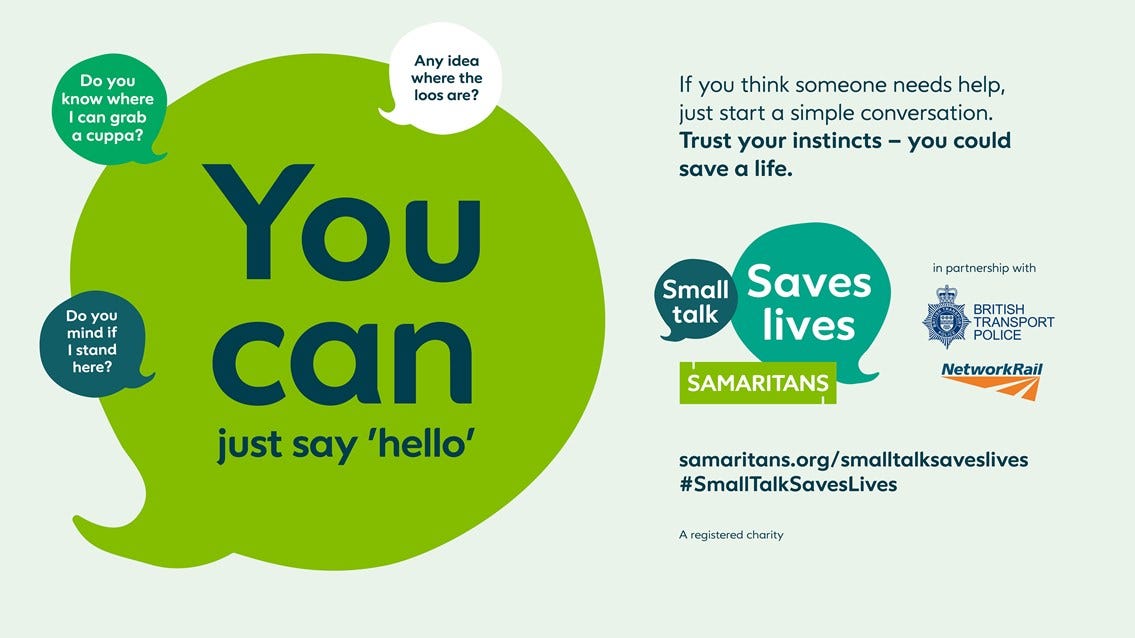
The atmosphere in the room would visibly change. Up until then, people could comfortably discuss “mental health”, “distress”, “depression”, “crisis”. But not the S word. Modern society has become reasonably competent at packaging mental health issues into socially manageable categories, and we’ve made genuine progress in opening discourse. Employers discuss wellbeing, universities run awareness campaigns, and corporations post infographics about burnout (while, of course, simultaneously creating the conditions that produce it). But suicide still inhabits a treacherous hinterland. Even among compassionate people who had voluntarily joined a suicide charity, there remained a strange fear surrounding the subject itself.
Volunteers would often say they were frightened that asking somebody whether they were suicidal might somehow implant the idea. That speaking the possibility aloud could cause it. As though suicide were less a human state of suffering and more a kind of contagious curse that could be summoned through language.
It is a bizarre myth, though perhaps an understandable one.
But, people avoid the question. They soften it, redirect it, or wrap it in euphemism.
“You’re not thinking of doing something silly are you?”. Something silly - this one always makes me laugh. Surely this is the ultimate non silly context? Clowns are silly (and terrifying, I admit). Boomerangs and didgeridoos are silly. Not wearing SPF is silly. I would have thought there isn’t much scope for silliness in the termination of one’s life, though maybe I am being unimaginative.
“You wouldn’t actually do anything though?”. ‘Anything’. Don’t say it. Don’t say the word, just say ‘anything’. They’ll know what I mean. Much safer.
“You’ve got so much to live for”. Right. So I’m ungrateful and deluded as well as miserable.
“Think of your kids”. Great. I’m suicidal AND a selfish prick. Nice one.
What often goes missing is genuine curiosity about the person’s experience. The individual in crisis rapidly senses that the conversation has become emotionally unmanageable for the person sat across. Their disclosure now carries an additional burden. They are no longer merely suffering. They are frightening people.
I gradually realised through Samaritans that one of the most powerful things you can offer somebody in despair is your ability to remain psychologically present while hearing something difficult. Many callers had spent years editing themselves around others. They had become experts in translating unbearable thoughts into socially acceptable fragments. “I’m tired”. “I can’t cope”. “I feel trapped”. Sometimes the call only truly began once someone calmly asked, “Are you thinking about ending your life?” without sounding horrified by the answer.
And this is perhaps the strange paradox surrounding suicide. The more unmentionable it becomes, the more isolated people become within it. Silence does not neutralise suicidal thinking. If anything, it gives it privacy to expand unchecked. Thoughts become fused with shame. Individuals begin relating not only to despair itself, but to the belief that their despair is fundamentally unspeakable and unsharable. Most people pull away from that terrain as quickly as possible.
But if my years with Samaritans taught me anything, it is that people rarely need perfection from others during moments of crisis. What they are often searching for is evidence that another human being can stay in the room with them psychologically while they articulate something terrifying (yet, oddly quite ubiquitous - we all have ‘dark’ thoughts. Are they even dark at all? Perhaps they are merely what makes us human? Anyway I digress). Being heard without immediate recoil can itself become destabilising in a positive sense. A person who has spent years convinced their thoughts are too dark to speak aloud suddenly discovers another nervous system capable of tolerating them.
Perhaps mental health discourse functions best when distress remains manageable and aesthetically presentable. Suicidal thinking disrupts that entirely. It exposes the limits of reassurance.
Still, we need to become collectively better at talking about it. Better at both asking direct questions and holding the space for difficult answers. If people learn that their most unsettling thoughts immediately produce panic, avoidance, or moral discomfort in others, they will continue doing what Annie demonstrated on that first day of training all those years ago: containing those thoughts alone while sitting silently beside everybody else. Until we say “I don’t get it - s/he always seemed so happy”.