Blue Skies, Barbed Wire
Prisons are, for obvious reasons, almost always in the middle of nowhere. The night before my first visit to a high-security prison, I went down a familiar rabbit hole of Google searches and forum threads, trying to get a handle on what I was about to walk into. What struck me quickly was how little I actually knew about how prisons were categorised, and how blunt the language was once I found it.
In the UK system, Category A is reserved for those “whose escape would be highly dangerous to the public or the police or the security of the State and for whom the aim must be to make escape impossible”. Category B covers those “for whom the very highest conditions of security are not necessary but for whom escape must be made very difficult” (I mean - mustn’t it always?!). Category C includes prisoners “who cannot be trusted in open conditions but who are unlikely to make a determined attempt to escape”. Category D, at the other end, consists of those “who can reasonably be trusted in open conditions”. I was heading into a Cat B prison which housed men convicted exclusively of serious violent offences, whose escape “must be made very difficult”. My mind wandered into prison architecture, fantasy escapology, and stereotypes of the kinds of people who are mandated to live in places that are hard to escape from. I recall wishing I looked more intimidating. I didn’t sleep well.
I skipped breakfast in the morning. I caught the bus to the train station three miles away, then took two trains towards the outskirts of Nottingham. After going through miles of countryside I finally arrived at the station nearest the prison. From there, I walked through a small village that felt almost deliberately ordinary. It was actually a beautiful day. Serene. One of those crisp autumn days with blue skies and a thin frost still clinging to the grass. People were out walking their dogs, moving carelessly, unhurried. There were stone houses, a small shop whose owner was probably a lovely old man called Clive or something, a few cars parked unevenly along the road, and a proper post office with a proper red pillar box outside. I love those things - they’re one of the few things about the UK that I’m rather proud of, not that I had anything to do with their creation. I walked on, almost forgetting about my agenda for the day. Then the fencing started to appear, then the wire, then the signs, and eventually the gates.
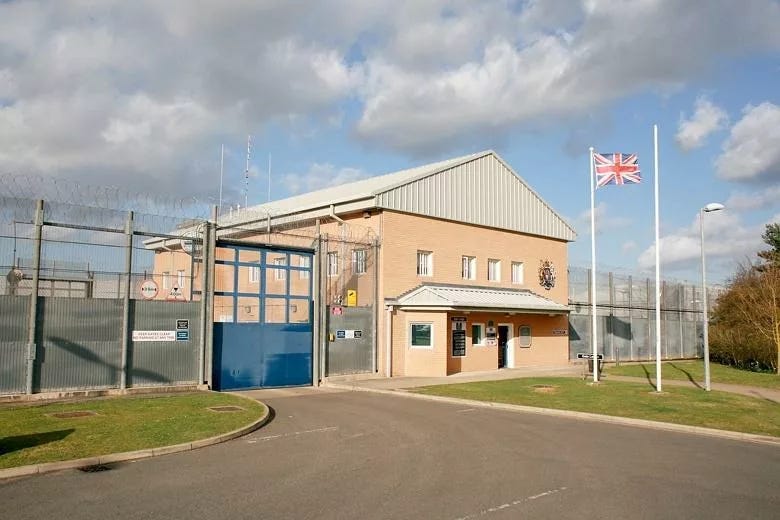
I remember feeling paradoxically irritated by how pleasant it all was. It felt mismatched. I was about to spend the day inside a prison, and yet everything leading up to it was calm, bright, almost inviting. There was a part of me that wanted the weather to cooperate with the ‘Mind Hunter’ type imagery that I had in my head. Rain would have made more sense. Even a storm. Something that foregrounded the bleakness of where I was going.
I do not intend to paint a Shutter Island version of prisons. They are not cinematic in that way, or any way. If anything, they are far more ordinary and far more drab. They feel closer to hospitals than anything else. Corridors, systems, routines, a kind of institutional blandness. But layered over that is a patent aesthetic of danger. And this doesn’t necessarily correlate to danger from the men inside, at least not in the way people tend to imagine, but the danger of getting something wrong. Saying the wrong thing. Missing a step in the process. Forgetting protocol. There is no room for improvisation in the total institution. No space for being off the cuff. And forget about your silly little jokes. Everything is deliberate. Every action, every sentence, every interaction. I felt that before I had even signed in.
Eight Gates In
Inside reception, I gave my details to someone behind a thick glass screen and stood waiting, suddenly aware of how visible I was. Why am I not taller? Wider? Sometimes they search you straight away, sometimes after. Either way, the tone is set quickly. It all feels a bit like when you go through an airport security line, except you’re not going to Italy, you’re going to a prison full of violent men who’d better not fuckin’ escape!
Then I was directed to the keys. They were kept in an electronically locked box behind the desk. When it opened, I would have a short window (fifteen seconds I think) to take them, else an alarm would sound. Then those keys would be tracked, with me, and obviously I’d need to return them to the same slot later on. If I didn’t, I’d be in a lot of trouble. Fair enough. When a buzzer signalled ‘open’, I reached in, quickly, took hold of them, and clipped them onto my belt. They were heavier than I expected. A chain connected my belt to the keys, which I was to clip shut in a leather pouch fixed to the belt. The keys were massive and a bit frightening - how can a key be frightening? I’m not cut out for this. I’m also notoriously bad at retaining keys.
They did not sit there quietly either. Whenever I moved, a dictatorial metallic jangle followed. Chain brushed against leather, keys knocked against each other. I could feel them against one side of my hip as I walked. On the other side was a rape alarm.
From there, I stepped into a glass chamber. The door closed behind me and I stood there while the electronic detection system scanned me. It was only a few seconds, but time stretched. Nothing to do, nowhere to look, just the hum of the machine and a totally irrational worry that I might be accidentally smuggling something. I’m an unwitting drug mule about to be sentenced to ten years in the slammer. Why does that happen? Like when a police car pulls up beside you and you suddenly feel like a criminal. Just me? Then there was a click, and the second door opened.
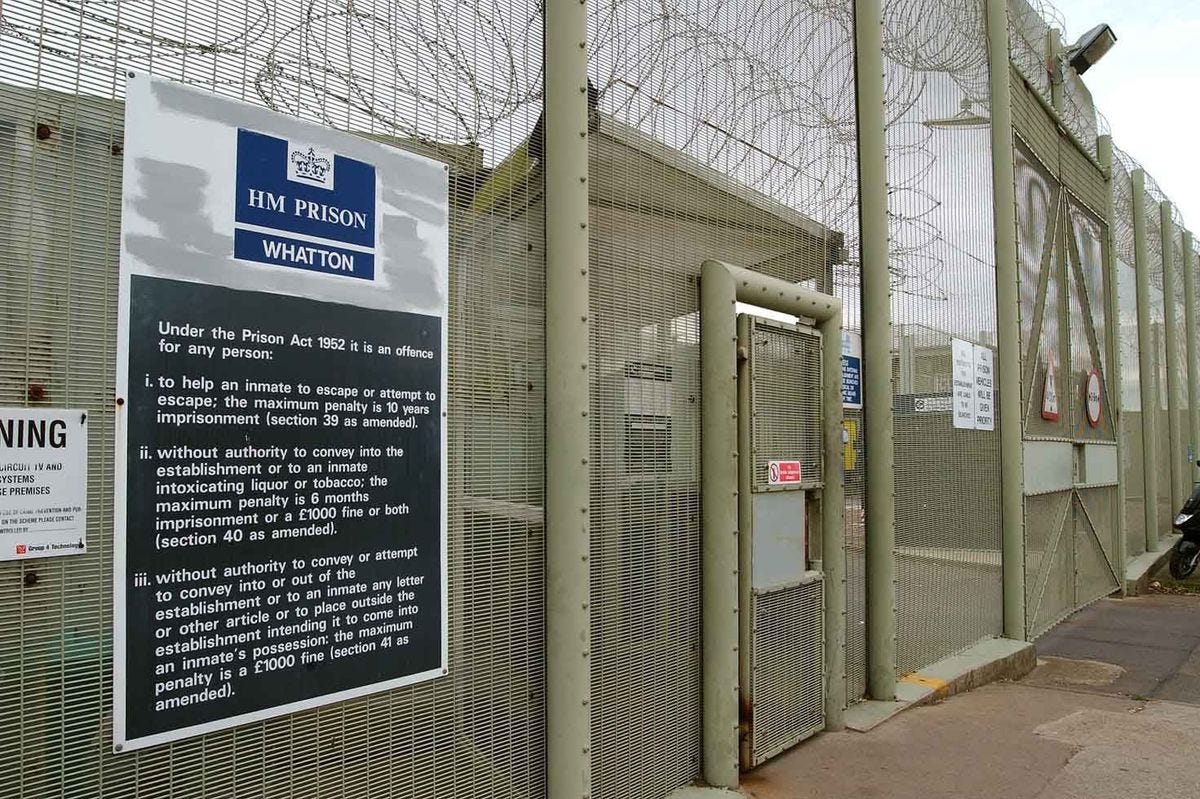
I stepped through into the outer perimeter. I love that word perimeter - it sounds so theatrical. Only bad things happen inside (or outside) perimeters. From that point on, the prison revealed itself one gate at a time. I walked up to the first gate and opened the leather pouch. I pulled the keys free, felt the chain release with a sharp jangle. I sorted through them, found the right one, pushed it into the lock, turned it, felt the resistance and then the give. The gate opened. I stepped through, turned back, closed it, and locked it behind me. I know it sounds very simple but I’ve never been so aware of such an inane routine. I was holding the keys too purposefully. Too tightly. Every movement was rigid. Hold your phone near the edge of a balcony and you’ll know what I mean.
Then the next gate. Same process. Same sounds. Same brief pause while I found the right key. And again.
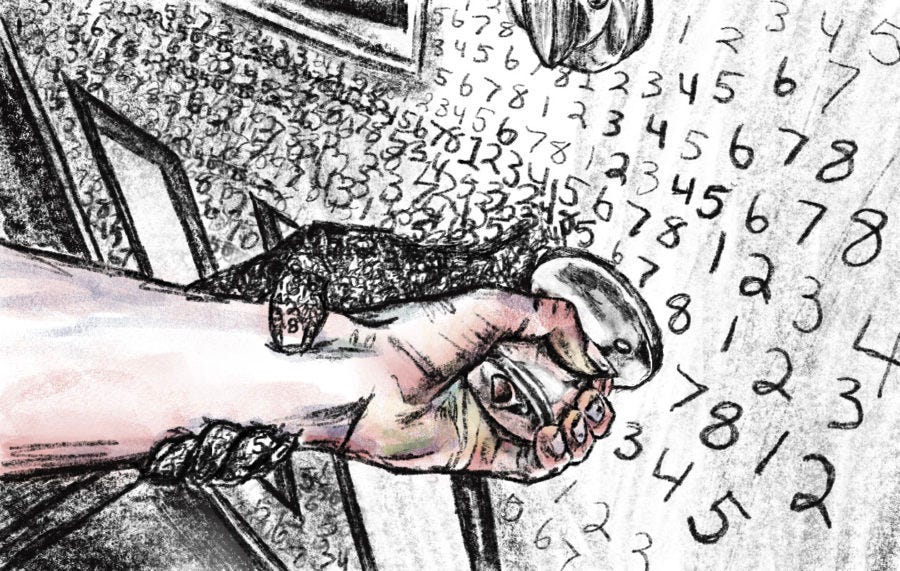
By the third or fourth gate, I was moving even more carefully. More deliberately. I was aware of my hands, my posture, the way I was standing, the way I was walking. I was listening more closely than usual. Paying attention to things I would normally ignore. I had become hyper-aware of myself.
Not in a reflective or mindful sense, not in a way that felt thoughtful or considered. It felt more like becoming a suspended version of myself. Held slightly above my own behaviour, monitoring it in real time. Making sure I was doing things correctly, even when I was not entirely sure what “correct” meant just yet. I did not fully know why.
There was no obvious threat in front of me. No one was shouting. Nothing dramatic was happening. But the environment itself carried a tension that settled into my body without making itself consciously known. It was in the sequence of gates, in the sound of the keys, in the pauses between spaces, in the knowledge that there was a right way to move through this place and if I screwed it up, someone might escape.
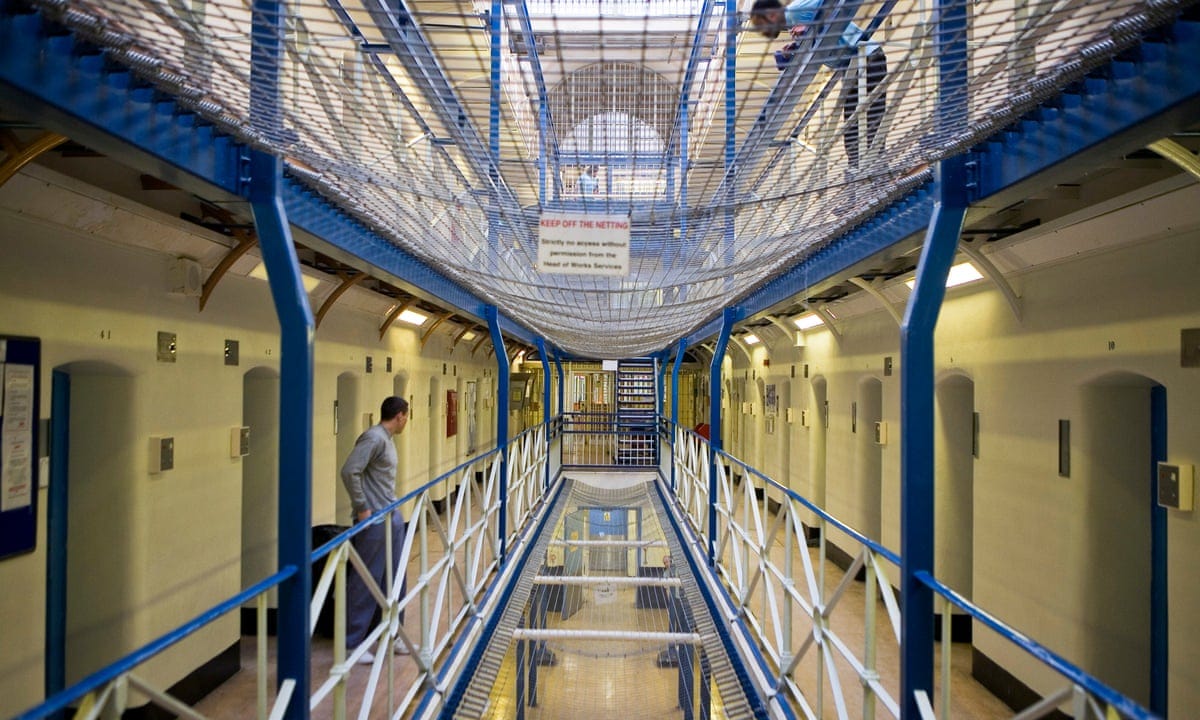
By the time I reached the inner wings, I had opened and closed around eight gates. Eight times pulling the keys, eight times turning the lock, eight times stepping through and closing something behind me. By then, my attention had narrowed. I was alert in a way that did not feel optional and it was draining. I hadn’t even started work, which involved undertaking research interviews with a bunch of men that the state considered to be seriously dangerous. I was twenty-six and I looked like I belonged in a shit boyband (is there any other kind?). Still, I had my rape alarm.
Living on Reduced Power
That first experience stayed with me because of what it revealed about how environments shape us before anything explicit happens. Nothing had gone wrong. No one had threatened me. No incident had taken place. It was all utterly unremarkable. And yet a portion of my capacity had already been used up simply by being there.
It felt like running on 70% battery.
I could still function. I could speak, listen, think clearly enough. But something had been allocated elsewhere. To vigilance. To monitoring. To holding myself between the lines of a system I hadn’t yet adapted to.
That missing thirty percent was evident in small ways. Less focus. Less ease. A sensitivity to things that would not normally bother me. A sense that I was slightly more contained, much less myself. And that was after a few hours.
The men living there did not get to step back out through the gates at the end of the day. They remained in that environment, where uncertainty, restriction, and a constant awareness of boundaries were part of daily life.
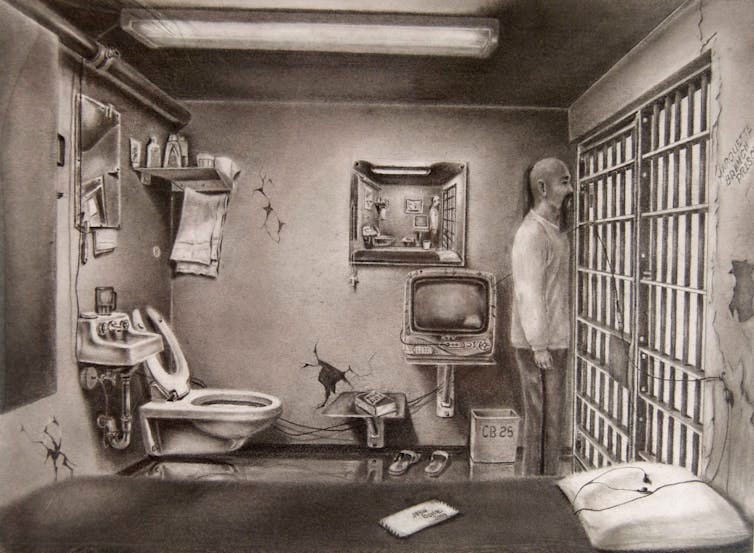
We tend to think about mental health as something internal, something located within the person. Their thoughts, their emotions, their coping strategies. But that first walk into the prison made me appreciate how much our environment counts. If the environment is tense, uncertain, restrictive, or threatening, a portion of your capacity is already being used before anything else begins. You are not starting from zero. You are starting from a reduced position.
I see versions of that everywhere now. We are all living with financial pressure, unstable work settings, conflict, legal issues, health concerns, structural circumstances where nothing is entirely secure, and nothing fully settles back to zero. In those conditions, we are rarely operating at full capacity.
Part of us is always elsewhere, monitoring, anticipating, holding things together.
We are hardly ever working with 100%.
What Is Your Environment Costing You?
Once you have felt what it is like to move through an environment that consumes your attention, step by step, gate by gate, it becomes much harder to ignore how much of a person’s capacity is shaped before they even begin to deal with whatever is in front of them. Alright. Now for the bit where this stops being about prisons and starts being about you. Have a little chew on these reflective questions:
What is your environment asking your nervous system to carry, every day, before anything else begins?
If you were honest about it, how much of your “battery” is already gone by the time you sit down to work, speak to people, or try to think clearly?
What are the background tensions in your life right now, the ones that never quite switch off but rarely get named?
Where are you being asked to stay vigilant, careful, or slightly on edge, even when nothing dramatic is happening?
How often do you judge your reactions without accounting for the conditions you are reacting within?
If you started from the assumption that you are not at 100%, what would you stop expecting from yourself?
What would become more understandable about your behaviour if you accepted that you might be operating at 70%, or even less?
Where in your life could something be made less tense, even slightly, rather than asking yourself to simply cope better?
What would it look like to design your day around the capacity you actually have, rather than the capacity you think you should have?
And if nothing external can change immediately, how might you create small pockets of relief, moments where your system is not being asked to stay on guard?