I have only published one book. I said ‘first’ because it suggests I am more accomplished, and who doesn’t like that?
I’ve decided to post three pages (below) directly from my book to see how it’s received here. Hey everyone, look at me.
It is obviously written in a far more academic style than most of what I usually post on Substack. It’s more formal and more dense. Maybe, depending on your tolerance for academic prose, it’s far too dry. I guess I’ll know quickly from impression/like stats (*rolls eyes*). Truthfully, this is the way I naturally write. It is the environment I have spent years in, and in many ways it still feels the most honest to me, intellectually.
One thing I’ve found embarrassingly difficult since starting this Substack shenanigans is trying to strike the balance between accessibility and precision. I do not mean “dumbing ideas down”. I have no interest in turning psychology, philosophy, or existential thought into Instagram self help and productivity clichés. But I do think there is something important about trying to make complex ideas usable, lived, and adaptable to people outside of academia.
FFS this is boring.
Academia trains you to qualify everything. To define every term, and to write defensively. You have to anticipate critique before it arrives. Sometimes I think that process damaged my creativity a bit (a lot). Or it made me suspicious (pretentious) over simplicity. At other times, I am incredibly grateful for it, because it taught me to think carefully, write rigorously, and resist the temptation to oversimplify complicated human experiences into neat little categories.
And he’s just only introducing the boring bit? FML
So, below are the first three pages of my book Peer Support in Prison: How incarcerated people make meaning through active citizenship. I’m curious how it feels to read in this space. If the style switch is especially notable. And other stuff. Don’t hold back.
The Myth of Sisyphus, Meaning, and the Absurd Condition
In The Myth of Sisyphus (1942), Albert Camus exposes an irresolvable absurdity inherent within the human condition: how does one find meaning in a universe seemingly unable to provide it? In the absence of any intrinsic or verifiably ‘true’ meaning to life, the individual’s ceaseless quest to discover it becomes fundamentally absurd. The absurd, then, “is born of this confrontation between the human need [for meaning] and the unreasonable silence of the world” (Camus, 1942, cited in Camus, 2013, p. 20).
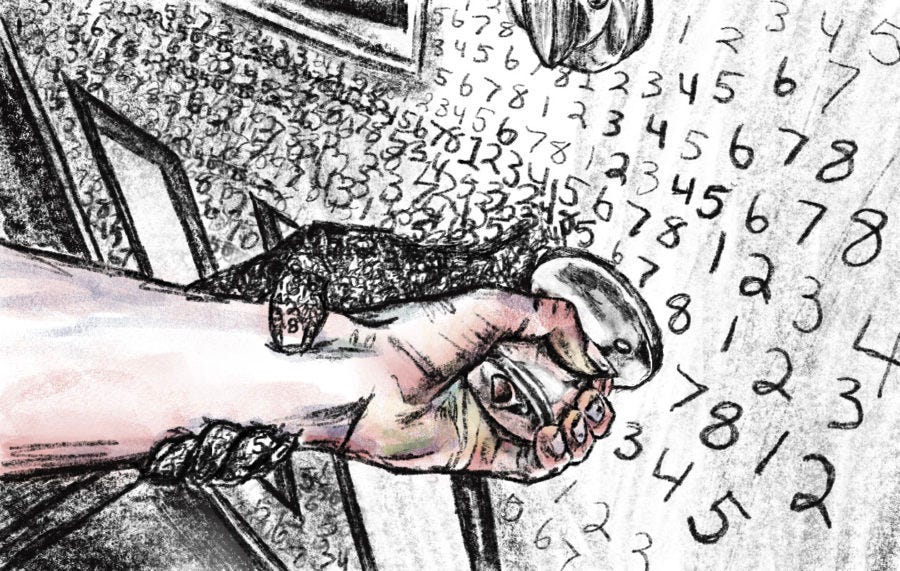
In storying this paradox, Camus invokes the mythological figure Sisyphus, a recalcitrant king condemned by the Gods to an infinite punishment in Tartarus, the Underworld. Sisyphus is sentenced to an eternity of futile labour: he is to push a giant boulder up a mountainside, only to watch it roll back down and repeat the cycle, ad infinitum. Camus is, of course, paralleling the human condition, where life’s daily rituals and routines constitute so much of an existence clouded by the looming inevitability of death.
“Rising, streetcar, four hours in the office or the factory, meal, streetcar, four hours of work, meal, sleep, and Monday Tuesday Wednesday Thursday Friday and Saturday according to the same rhythm”. (Camus, 2013, p. 10)
What does it all mean?
In essence, Sisyphus symbolises the human struggle to locate meaning in a world that can appear callous, drab, or indifferent. Here, Camus is especially interested in the human judgement over whether or not life is worth living, positing therefore that suicide is the only serious philosophical concern. Within the desolation and existential anguish of ‘absurd walls’, suicide affords an end to the “incalculable feeling that deprives the mind of the sleep necessary to life” (Camus, 2013, p. 6). Suicide, then, is a confession that recognises “the absence of any profound reason for living, the insane character of that daily agitation, and the uselessness of suffering” (p. 6). Yet it is a confession, or final submission, that most humans do not make.
While most of us will experience the angst and entrapment of the ‘absurd universe’, recognising at points the meaninglessness and misery of the human condition, we continue to live, and in doing so revolt against any compulsion towards a “divorce between man and his life” (p. 6). It is through this act of existential rebellion that one can come to live meaningfully alongside an awareness of the absurd paradox, drawing purpose from the methods of living freely despite the Damoclean imposition of mortality, finitude, and universal indifference.
At this juncture, humans can find themselves narrowed into a dual system for approaching life. This dichotomy is marked by a choice to embrace religious or ideological systems that offer arbitrary yet convenient explanations for the universe’s evasive ‘plan’ (what Camus called ‘philosophical suicide’) or confront existential absurdity forthrightly and live in a state of ‘conscious revolt’. In critiquing the former, Camus contests that ‘a world that can be explained even with bad reasons is a familiar world’, seemingly taking issue with the superficiality and self-deception required for philosophical suicide. Commenting on the latter, Camus reasons that “to abolish conscious revolt is to elude the problem” (Camus, 2013, p. 36). Resolving the problem of absurdity, therefore, requires an ontological acceptance of and elasticity between the intrinsic meaninglessness of existence and the will to go on regardless. Only through this oscillation can individuals find both authenticity and freedom.
Indeed, despite the stark futility of his fate, Sisyphus adapts and emerges into a defiant and autonomous self, bringing his labour into his own framework of utility and reason. As he confronts and embraces the absurdity of his existence, foregoing the impulse to struggle against overwhelming nothingness, an alternative approach for ‘being’ emerges. Instead of pursuing some cosmic and extrinsic certainty of what it is to be, Sisyphus finds meaning and purpose in his own conscious experience of existence and his inherent rebellion against the Gods. Here, there appears to be a reconstruction of ‘meaning’, from something that is pursued as an exterior, objectifiable, and knowable truth, towards something which is created by the individual and obeyed authentically, despite its dubiousness and metaphysicality. Along these lines, Camus observes that “a man defines himself by his make-believe as well as by his sincere impulses” (p. 9). Meaning making, then, regardless of its multifarious relationship with ‘truth’, appears critical to surviving absurd social conditions.
While the imperative here is not to fabricate ‘bad reasons’ for the purpose of quelling existential nausea, consciousness itself and the interminable narrativisation of being is, in and of itself, a meaningful creation. It is within such internal dialogues that opportunities for the construal and reconstrual of one’s own meaning and purpose become possible. For Sisyphus, this is integral to surmounting his absurd fate.
“I leave Sisyphus at the foot of the mountain. One always finds one’s burden again. But Sisyphus teaches the higher fidelity that negates the Gods and raises rocks. This universe henceforth without a master seems to him neither sterile nor futile. Each atom of that stone, each mineral flake of that night-filled mountain, in itself, forms a world. The struggle itself toward the heights is enough to fill a man’s heart. One must imagine Sisyphus happy. (Camus, 2013, p. 78)
Camus invites us to accept that while we may, at times, be required to confront the inherent absurdity of life, unable to breakout from the entrapment this creates, we can come to intentionally notice our response to such conditions, and in doing so carve out space for the discomfort of uncertainty. Here, we can rebel against the despair this might provoke and find meaning and authenticity in the act of living itself. This presents a more adaptive approach to absurdity, within which one can cultivate internally significant facets of meaning, rather than relentlessly interrogating the unfairness and injustice of a disinterested universe.